
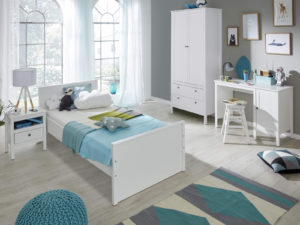
The children’s bedroom should be a place of well-being where the little ones love to retreat to play, learn and sleep. However, many children’s bedrooms are very small and (apparently) don’t offer much room for creativity. But quite the opposite: with the following suggestions and furnishing ideas you can transform even the smallest rooms into a fantastic bedroom for your son or daughter.
1. The fundamental point: a well-thought-out layout of the room
The layout of the rooms must be carefully studied, especially in small rooms. Where should the bed be? Which place is particularly bright and therefore suitable for a desk? Is there enough space for a closet and if so, where? If you have answered these questions, you are already a big step closer to your dream of a beautiful and inviting bedroom. A sensible division of the room into sleeping area, work area and play area can also be done by using different colors or dividers. In this case, open shelves are advisable because they let in enough light, do not seem restrictive and at the same time offer plenty of storage space.
2. Less is often more
Small children’s rooms quickly appear disorganized. To prevent this from happening, it is advisable to clean regularly. For example, you can donate or donate clothes and toys that you no longer need sold via the flea market app become. However, you should store seasonal clothing and items that your child may still want to use, well-packed, in the basement or attic. Why: Only things that will actually be used regularly should be stored in a children’s bedroom. However, storage space is often limited. It is therefore important to make optimal use of small niches and corners, for example under the bed, above the wardrobe or behind the door. For example, toys that your children only occasionally play with can be stored in boxes on top of the wardrobe. Tip: Use boxes with colorful patterns, as they are very decorative and do not negatively affect the overall look of the room.
3. Space-saving children’s furniture for small rooms
Large, bulky furniture has no place in a children’s bedroom. Instead, rely on space-saving children’s furniture that ideally has multiple functions. Stools, for example, are very practical because they not only serve as a seat but also offer plenty of space for storing objects. Beds with integrated drawers and compartments are also suitable for children’s bedrooms.
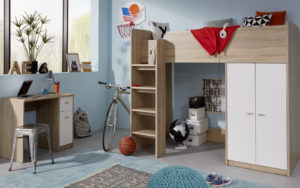
Even older children, aged six and up, can enjoy a loft bed: while they sleep upstairs, the space below serves as a place to store a desk, toy boxes or even as a cozy snuggle cave. Even if two children have to share a room, a bunk bed is the ideal solution. However, make sure it is equipped with a straight ladder, as a sloping ladder would only take up additional space. In this case, the space under the bed can also be used as storage space, for example with the help of an underbed chest of drawers or a drawer that children can pull out independently.
We recommend a changing table for the baby’s room that can be easily folded away when not in use. Additionally, shelves and cabinets with shallower depths are generally better suited for small rooms. However, they should always be screwed to the wall so that they cannot fall. Older children need a desk for learning, painting and crafting. This is better integrated into the window area because it takes up less space here. Your baby also benefits from plenty of natural light.
4. Choose colors intelligently
Children love colorful things, but you should choose colors conservatively, because small rooms can quickly appear overcrowded. Instead, rely on a clear, direct color concept and a combination of just a few bright, harmonious colours. If you want to wallpaper the room, choose wallpaper with vertical stripes – it visually enlarges the room, which is especially advantageous for sloping ceilings. When designing with wall paint, experts recommend leaving a white border under the ceiling, that is, painting it only up to just below the ceiling. This way the room will seem bigger and your baby won’t feel cramped so soon. If the children’s room is very narrow, it is better to use two different colors: paint the long wall with a light color and the short wall with a darker color. Color-coordinated decorative objects and floor-length curtains (preferably white or beige) harmoniously complement the furnishing concept and create a feel-good atmosphere.
5. Advice for choosing materials and lighting
You should also stick to a common thread when it comes to materials, otherwise you risk making the room seem restless and your child not feeling at ease. Furniture made of light wood or painted in light colors is particularly recommended. Additionally, mirrors and shiny metal surfaces are always a good choice because they automatically make the room seem larger. And when it comes to light: play with lots of small light sources and use them specifically for reading and playing. However, a large light source in the form of a bright ceiling lamp should not be missing, so that you can brightly illuminate the entire room if necessary.
6. It becomes really beautiful just with decorations
No matter how small the children’s room may be, decoration should absolutely not be missing. Home textiles, in particular, are a good way to create an inviting and welcoming atmosphere. A carpet in front of the bed not only looks beautiful, but also prevents cold feet when you get up, especially if there is laminate underneath. In order for your children to play on the floor, you should also equip the room with a thick play carpet. Be careful though: the carpets and bridges that rest on the actual floor covering must be chosen for size and quality so that they do not hinder the opening and closing of the doors. Also provide comfort with large seat cushions and ottomans. These are not only for relaxing, but also offer space for several children if visitors come.
It is best to design the walls together with your children, as long as they are large enough. Choose paintings and wall stickers together – if your child’s tastes change, you can easily swap them out to provide variety without much effort. Basically you should not overdo the decoration, so that the room does not appear too busy.
7. Conclusion: There is space in the smaller hut
Attractive design of a children’s bedroom can be a challenge. However, if you plan the room intensively, carefully choose furniture and decorative objects and skilfully use corners and niches as support space, you will be able to create, despite the lack of space, a small paradise for your children, in which they will feel completely at home.
latest posts published

You should definitely pay attention to this!

Indoor gardening trend: green happiness for your home

The best design shops in Riga (Latvia)

Living ideas for Scandinavian furnishings

Christmas 2025: our trendy gifts in the shop

Insider tip for Christmas: designer jewelery from the Baltics!

What is the difference between a chest of drawers and a sideboard? Let’s find out!

Decorate your living room and bedroom in Scandinavian style

Muista office stool for more fun at work
